History Online

MYTHOLOGY
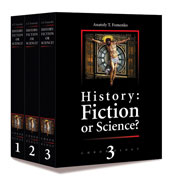
Learn how and why Ancient Rome, Greece and Egypt were invented during Renaissance.

624 pages
446 illustrations


History: Fiction or Science?

This book shall change your entire perception of history! What if Ancient Rome, Greece and Egypt were invented during Renaissance? What if Old Testament was a rendition of events of Middle Ages and was written well after the Gospels? What if Jesus Christ was born in 1053 and crucified in 1086 AD?

Sounds unbelievable? Not after you've read "History: Fiction or Science?" by Anatoly Fomenko, leading mathematician of our time. He follows in steps of Sir Isaac Newton and finds clear evidence of falsification of History. Armed with logic, astronomy and computers he proves the history of humankind to be both dramatically different and drastically shorter than generally presumed.

Archaeological, dendrochronological, paleographical and carbon methods of dating of ancient sources and artifacts are both non-exact and contradictory, therefore there is not a single piece of firm written evidence or artifact that could be reliably and independently dated earlier than the XI century.

The consensual chronology we live with was essentially crafted in the XVI century from the contradictory mix of innumerable copies of ancient Latin and Greek manuscripts (all originals have mysteriously disappeared) and the "proofs" delivered by the late mediaeval astronomers, cemented by the authority of writings of the Church Fathers.

In fact, for the last 300 years, the whole class of historians created, researched, perfected and polished a world of phantom universal history and classical civilization artfully constructed by their predecessors in the course of XVI-XVIII centuries at the command of powers of that time. They have polished the real world history into oblivion!

"History:Fiction or Science?", supplies You with sufficient proof to reach step by step for yourself the inevitable conclusion that the classical chronology is false and therefore, that the history of ancient and medieval world, is also FALSE. After reading this book you will certainly have a fresh and very suspicious outlook on "ancient" and "enigmatic" Roman, Greek and Egyptian, mediaeval as well as all other "lost and found" civilizations.


This book crowns over 30 of meticulous and extensive research.
Henry Ford once said: "History is more or less bunk!"
Prominent mathematician Anatoly Fomenko proves it.


Contents

Chapter 1 The problems of historical chronology

1. Roman chronology as the foundation of European chronology
2. Scaliger, Petavius, and other clerical chronologers.
The creation of contemporary chronology of the ancient times in the XVI-XVII century a.d.
3. The veracity of the Scaliger-Petavius chronology was questioned as early as the XVI century
3.1. Who criticized Scaliger's chronology and where.
3.1.1. De Arcilla, Robert Baldauf, Jean Hardouin, Edwin Johnson, Wilhelm Kammeyer
3.1.2. Sir Isaac Newton
3.1.3. Nikolai Alexandrovich Morozov
3.1.4. Recent publications of German scientists containing criticisms of Scaliger's chronologY.
3.2. The questionnable veracity of the Roman chronology and history.
The hypercritical school of the XIX century
4. The problems in establishing a correct chronology of "ancient" Egypt
5. The problem in dating the "ancient" sources.Tacitus and Poggio
Cicero and Barzizza. Vitruvius and Alberti
6. Timekeeping in the Middle Ages. Historians discuss the "chaos reigning in the mediaeval datings."
Peculiar mediaeval anachronisms
7. The chronology and the dating of Biblical texts
8. Difficulties and contradictions arising from the reading of old texts
8.1. How does one read a text written in consonants exclusively? The vocalization problem
9. Problems in the Scaligerian geography of Biblical events
9.1. Archaeology and the Old Testament
9.2. Archaeology and the New Testament
10. Ancient historical events: geographic localization issues
10.1. The locations of Troy and Babylon.
13.3. The alleged acceleration of the destruction of the "ancient" monuments
10.2. The geography of Herodotus is at odds with the Scaligerian version
10.3. The inverted maps of the Middle Ages
11. A modern analysis of Biblical geography
12. The mysterious Renaissance epoch as a product of the Scaligerian chronology
13. The foundations of archaeological methods have been based
on the Scaligerian chronology from the very beginning
13.4. When did the construction of the Cologne Cathedral really begin?
13.5. Archaeological methods are most often based on Scaliger's datings
13.6. One of the numerous problems of the Scaligerian history
the problem of bronze manufacture before the discovery of tin.
14. The problems and deficiencies of dendrochronology and several other dating methods
14.1. The consequent scale of dendrochronological datings does not extend
further back in time than the X century a.d.
14.2. Sedimentary layer datings. The methods of radium-uranium and radium-actinium analysis
15. Are radiocarbon datings to be trusted?
15.1. The radiocarbon datings of ancient, mediaeval, and modern specimens are scattered chaotically
15.1.1. Libby's initial idea. The first failures
15.1.2. A criticism of the application of the radiocarbon method to historical specimens
15.2. The dating of the Shroud of Turin
15.3 Modern radiocarbon analysis of Egyptian artefacts demonstrates serious contradictions
16. Critical analysis of the hypotheses on which the radiocarbon method is based. By A. S. Mishchenko
16.1. W. F. Libby's initial idea
16.2. Physical basics of the radiocarbon method
16.3. The hypotheses that the radiocarbon method is based upon
16.4. The moment of the object's departure from the exchange reservoir
16.5. Radiocarbon content variations in the exchange reservoir
16.6. Variations in radiocarbon content of living bodies
18. Numismatic datings

Chapter 2 Astronomical datings

1. The strange leap of parameter D" in the Theory of Lunar Motion
2. Are the "ancient" and mediaeval eclipses dated correctly?
2.1. Some astronomical data
2.2. The discovery of an interesting effect: an unprejudiced astronomical dating
shifts the dates of the "ancient" eclipses to the Middle Ages
2.3. Three eclipses described by the "ancient" Thucydides
2.4. The eclipses described by the "ancient" Titus Livy
3. Transferring the dates of the "ancient" eclipses forward in time into the Middle Ages
eliminates the enigmatic behaviour of the parameter D".
4. Astronomy moves the "ancient" horoscopes into the Middle Ages
4.1. The mediaeval astronomy
4.2. The method of unprejudiced astronomical dating
4.3. Many "ancient astronomical observations" may have been theoretically calculated
by late mediaeval astronomers and then included into the "ancient" chronicles as "real observations"
4.4. Which astronomical "observations of the ancients" could have been
a result of late mediaeval theoretic calculations?
5. A brief account of several examples of Egyptian Zodiacs
5.1. Some general observations
5.2. The Dendera Zodiacs
5.3. The horoscopes of Brugsch and Flinders Petrie
5.4. Finite datings of the Egyptian Zodiacs based on their complete deciphering,
as obtained by A. T. Fomenko and G. V. Nosovskiy in 2001
5.5. On the errors of E. S. Goloubtsova and Y. A. Zavenyagin 6. Astronomy in the New Testament

Chapter 3 The new dating of the astronomical horoscope as described in the Apocalypse

By A. T. Fomenko and G. V. Nosovskiy
1. The proposed research method
2. General information about the Apocalypse and the time of its creation
3. Ursa Major and the throne
4. The events took place on the Isle of Patmos
5. The constellations of Cassiopeia and the throne were drawn as Christ
sitting on his throne in the Middle Ages
6. The Milky Way
7. Twenty-four sidereal hours and the constellation of the Northern Crown
8. Leo, Taurus, Sagittarius, Pegasus
9. The daily rotation of the Northern Crown
10. Equine planetary images in mediaeval astronomy
11. Jupiter is in Sagittarius
12. Mars is beneath Perseus in either Gemini or Taurus
13. Mercury is in Libra
14. Saturn is in Scorpio
15. The Sun is in Virgo with the Moon underneath the feet of the latter
16. Venus is in Leo
17. The astronomical dating of the Apocalypse by the horoscope it contains
18. Our reconstruction of the initial content of the Apocalypse

Chapter 4 Astronomy in the Old Testament

1. Mediaeval astronomy in the Old Testament Book of Ezekiel
1.1. The title of the book
1.2. The description of the Milky Way and the Ophiuchus constellation
1.3. The Biblical description of the astronomical sectors, or "wings," on the celestial sphere
1.4. The constellations of Leo, Taurus and Aquila
1.5. The Biblical description of the mediaeval "wheels," or planetary orbits
1.6. Parallels with the astronomical symbolism of the Apocalypse
1.7. Biblical cherubim, chariots, and mediaeval planetary orbital wheels
1.8. The Biblical description of mediaeval cosmology as a celestial temple
2. The Biblical prophecy of Zechariah and the date of its creation
3. The Biblical prophecy of Jeremiah and the date of its creation
4. The Biblical prophecy of Isaiah and the date of its creation
5. The Biblical prophecy of Daniel and the date of its creation

Chapter 5 The methods of dating the ancient events offered by mathematical statistics

1. The local maxima method
1.1. The historical text volume function
1.2. The maxima correlation principle
1.3. Statistical model
1.4. Experimental test of the maxima correlation principle.
Examples of dependent and independent historical texts
1.5. Method of dating the historical events
2. Volume functions of historical texts and the amplitude correlation principle.
By A. T. Fomenko and S. T. Rachev
2.1. Dependent and independent chronicles. Volume function maxima correlletions
2.2. Rich and poor chronicles and chronicle zones
2.3. Significant and insignificant zeroes of volume functions
2.4. The information respect principles
2.5. The amplitude correlation principle of volume graphs in the poor zones of chronicles
2.6. Description of statistical model and formalization
2.7. The hypothesis about the increase of the "form" parameter of a chronicle in the course of times
2.8. The list and characteristics of the Russian chronicles we investigated
2.9. The final table of the numeric experiment
2.10. Interesting consequences of the numeric experiment. The confirmation of the statistical model
2.11. Comparison of a priori dependent Russian chronicles
2.12. Comparison of a priori independent Russian chronicles
2.13. Growth of form parameter in the course of time
for the Russian chronicles after the XIII century
2.14. Growth of the average form parameter over the course of time for groups
of Russian chronicles of the XIII-XVI century
2.15. Growth of the average parameter of form over the course of time for the groups
of Russian chronicles of the alleged IX-XIII century
2.16. Chronological shift by 300 or 400 years in Russian history
2.17. Conclusions
3. The maxima correlation principle on the material of the sources pertinent to
the epoch of Strife in the History of Russia (1584-1619)
By A. T. Fomenko, N. S. Kellin and L. E. Morozova
4. The method for the recognition and dating of the dynasties of rulers.
The small dynastic distortions principle
4.1. The formulation of the small dynastic distortions principle
4.2. The statistical model
4.3. Refinement of the model and the computation experimens
4.4. Result of the experiment: coefficient c(a, b) positively distinguishes
between the dependent and independent dynasties of kings
4.5. The method of dating the royal dynasties and the method detecting the phantom dynastic duplicates
5. The frequency damping principle.The method of ordering of historical texts in time
6. Application of the method to some concrete historical texts
7. Method of dating of the events
8. The frequencies duplication principle. The duplicate detection method
9. Statistical analysis of the Bible
9.1. Partition of the Bible into 218 "generation chapters"
9.2. Detection of the previously known duplicates in the Bible with the aid of the frequency dumping principle
9.3. New, previously unknown duplicates we discovered in the Bible.
General scheme of their distribution within the Bible
9.4. A representative example: the new statistical dating of the Apocalypse,
which moves from the New Testament into the Old Testament
10. The method of form-codes. The comparison of two long currents of regal biographies
11. Correct chronological ordering method and dating of ancient geographical maps

Chapter 6 The construction of a global chronological map and the results of applying

mathematical procedures of dating to the Scaligerian version of the ancient history
1. Textbook of ancient and mediaeval history in the consensual Scaliger-Petavius datings
2. Mysterious duplicate chronicles inside the "Scaliger-Petavius textbook"
3. Mysterious duplicate regal dynasties inside the "textbook by Scaliger-Petavius"
4. Brief tables of some astonishing dynastic parallelisms
5. Conformity of results obtained by different methods
5.1. General assertion
5.2. The agreement of the different methods on the example of the identification
of the Biblical Judaic reign with the Holy Roman Empire of allegedly X-XIII century a.d.
6. The general layout of duplicates in "the textbook by Scaliger-Petavius".
The discovery of the three basic chronological shifts
7. The Scaligerian textbook of the ancient history glued together
four duplicates of the short original chronicle
8. The list of phantom "ancient" events which are phantom duplicates, or reflections of the mediaeval originals
9. Identification of the "ancient" Biblical history with the mediaeval European history
10. Our hypothesis: history as described in surviving chronicles only begins in ca. the X century a.d.
We know nothing of the events that took place before the X century a.d.
11. Authentic history only begins in XVII century a.d.
The history of the XI-XVI century is largely distorted. Many dates of the XI-XVI century require correction
12. The radical distinction of our chronological concept from the version of N. A. Morozov
13. The hypothesis about the cause of the fallacious chronological shifts
in the creation of the history of antiquity
13.1. Chronological shift of a thousand years as the consequence of the fallacious dating of Jesus Christ's life
13.2. The letter "X" formerly denoted the name of Christ, but was later proclaimed to stand for the figure of ten.
The letter "I" formerly denoted the name of Jesus, but was later proclaimed to be the indication of one thousand
13.3. Until the XVIII century, the Latin letters "I" or "J" - i.e. the first letters of the name of Jesus -
were still used in several European regions to denote "one" in recording of dates
13.4. How the chronological shift by 330 or 360 years could have occured
13.5. What latin letters "M", "D", "C" in Roman dates meant originally, in the Middle Ages
13.5.1. General idea
13.5.2. Example: the date on the tomb of Empress Gisela
13.5.3. Another example: the date on the headstone of Emperor Rudolf Habsburg
13.5.4. Recording of mediaeval dates was not unified everywhere even in the XVIII century
13.5.5. Some datings of printed books and manuscripts dating from the XV-XVII century
will apparently have to be moved forwards in time by at least fifty more years
13.6. The foundation date of Rome of Italy
13.7. A later confusion of foundation dates of the two Romes, on the Bosporus and in Italy.
13.8. Scaliger and the Council of Trent. Creation of the Scaligerian chronology
of antiquity in the XVI-XVII century
13.9. Two phantom "ancient" reflections of Dionysius Petavius, a mediaeval chronologist of the XVII century
14. A stratified structure of the Scaligerian textbook of ancient history
15. The coordination of a new astronomical dating with a dynastic parallel
16. A strange lapse in the Scaligerian chronology near "the beginning of the new era"

Chapter 7 "Dark Ages" in mediaeval history

1. The mysterious Renaissance of the "Classical Age" in mediaeval Rome
1.1. The lugubrious "Dark Ages" in Europe that presumably succeeded the beauteous "Classical Age"
1.2. Parallels between "antiquity" and the Middle Ages that are known to historians, but misinterpreted by them
1.3. Mediaeval Roman legislators convene in the presumably destroyed "ancient" Capitol
1.4. The real date when the famous "ancient" statue of Marcus Aurelius was manufactured
1.5. Could the "ancient" Emperor Vitellius have posed for the mediaeval artist Tintoretto?
1.6. The amount of time required for the manufacture of one sheet of parchment
1.7. The "ancient" Roman Emperor Augustus had been Christian, since he wore a mediaeval crown with a Christian cross
2. The "ancient" historian Tacitus and the well-known Renaissance writer Poggio Bracciolini
3. The mediaeval Western European Christian cult and the "ancient" pagan Bacchic celebrations
4. Petrarch (= Plutarch?) and the "Renaissance of antiquity"
4.1. How Petrarch created the legend of the glory of Italian Rome out of nothing
4.2. Petrarch's private correspondence with people considered "ancient characters" nowadays
5. "Ancient" Greece and mediaeval Greece of the XIII-XVI century
5.1. The history of the mediaeval Athens is supposed to be obscured by darkness up until the XVI century
5.2. Greece and the Crusades
5.3. The history of Greek and Athenian archaeology is relatively short
5.4. The tendentious distortion of the image of mediaeval Athens in the "restoration works"
of the XIX-XX century
6. Strange parallels in the Scaligerian history of religions
6.1. Mediaeval Christianity and its reflection in the Scaligerian "pagan antiquity"
6.2. Mediaeval Christianity and "ancient" Mithraism
6.3. References to Jesus Christ contained in "ancient" Egyptian artefacts
6.4. Researchers of the ancient religions commenting on the strange similarities
between the cults of "antiquity" and those of the Middle Ages
6.5. Moses, Aaron and their sister Virgin Mary on the pages of the Koran
6.6. The XI century as the apparent epoch of St. Mark's lifetime.
The history of St. Mark's Cathedral in Venice
7. The "ancient" Egypt and the Middle Ages
7.1. The odd graph of demotic text datings
7.2. The enigmatic "revival periods" in the history of "ancient" Egypt
7.3. The ancient Hittites and the mediaeval Goths
8. Problems inherent in the Scaligerian chronology of India
9. Was the artificial elongation of ancient history deliberate?

Annexes

2.1. (to chapter 2) Grammatical analysis of an eclipse description in History by Thucydides. By Y. V. 471
5.1. (to chapter 5) Per annum volume distribution in some Russian chronicles
5.2. (to chapter 5) Frequency matrix of names and parallels in the Bible By V. P. Fomenko and T. G. Fomenko
6.1. (to chapter 6) Per annum volume distribution in The History of the City of Rome
in the Middle Ages by F. Gregorovius
6.2. (to chapter 6) Per annum volume distribution in The Roman History
from the Foundation of the City by Titus Livy
6.3. (to chapter 6) Per annum volume distribution in the book by Baronius describing mediaeval Rome
6.4. (to chapter 6) The "double entry" of the Biblical royal reigns of Israel and Judah
6.5. (to chapter 6) Armenian history. Emperors of the Holy Roman Empire of the alleged X-XIII century a.d., a.k.a. the Kings of Judah, a.k.a. the mediaeval Armenian Catholicoses
1. Three phantom reflections of the same mediaeval dynasty
2. The parallelism between the mediaeval Armenian history
and the phantom Roman Empire according to Scaliges
6.6. (to chapter 6) The identification of the "ancient" Kingdom of Judah with the Holy Roman Empire of the alleged X-XIII century a.d. The correlation between reign durations and biographical volumes

Age of Fable: Stories of Gods and Heroes

Thomas Bulfinch (1796-1867)

   Religions    Roman gods    Prometheus    Apollo    Juno
   Diana    Phaeton    Glaucus    Pygmalion    Venus
   Cupid    Echo    Narcissus    Minerva    Golden Fleece I
   Atlas    Sphinx    Pegasus    Medusa    Golden Fleece II
   Centaurs    Hercules    Bacchus    Troyan war    The Iliad

Religions of ancient Greece

THE RELIGIONS of ancient Greece and Rome are extinct. The so-called divinities of Olympus have not a single worshipper among living men. They belong now not to the department of theology, but to those of literature and taste. There they still hold their place, and will continue to hold it, for they are too closely connected with the finest productions of poetry and art, both ancient and modern, to pass into oblivion.

We propose to tell the stories relating to them which have come down to us from the ancients, and which are alluded to by modern poets, essayists, and orators. Our readers may thus at the same time be entertained by the most charming fictions which fancy has ever created, and put in possession of information indispensable to every one who would read with intelligence the elegant literature of his own day.

In order to understand these stories, it will be necessary to acquaint ourselves with the ideas of the structure of the universe which prevailed among the Greeks-the people from whom the Romans, and other nations through them, received their science and religion.

The Greeks believed the earth to be flat and circular, their own country occupying the middle of it, the central point being either Mount Olympus, the abode of the gods, or Delphi, so famous for its oracle.

The circular disk of the earth was crossed from west to east and divided into two equal parts by the Sea, as they called the Mediterranean, and its continuation the Euxine, the only seas with which they were acquainted.

Around the earth flowed the River Ocean, its course being from south to north on the western side of the earth, and in a contrary direction on the eastern side. It flowed in a steady, equable current, unvexed by storm or tempest. The sea, and all the rivers on earth, received their waters from it. The northern portion of the earth was supposed to be inhabited by a happy race named the Hyperboreans, dwelling in everlasting bliss and spring beyond the lofty mountains whose caverns were supposed to send forth the piercing blasts of the north wind, which chilled the people of Hellas (Greece). Their country was inaccessible by land or sea. They lived exempt from disease or old age, from toils and warfare. Moore has given us the "Song of a Hyperborean," beginning

"I come from a land in the sun-bright deep,
Where golden gardens glow,
Where the winds of the north, becalmed in sleep,
Their conch shells never blow."

On the south side of the earth, close to the stream of Ocean, dwelt a people happy and virtuous as the Hyperboreans. They were named the Æthiopians. The gods favored them so highly that they were wont to leave at times their Olympian abodes and go to share their sacrifices and banquets.

On the western margin of the earth, by the stream of Ocean, lay a happy place named the Elysian Plain, whither mortals favored by the gods were transported without tasting of death, to enjoy an immortality of bliss. This happy region was also called the "Fortunate Fields," and the "Isles of the Blessed." We thus see that the Greeks of the early ages knew little of any real people except those to the east and south of their own country, or near the coast of the Mediterranean. Their imagination meantime peopled the western portion of this sea with giants, monsters, and enchantresses; while they placed around the disk of the earth, which they probably regarded as of no great width, nations enjoying the peculiar favor of the gods, and blessed with happiness and longevity.

The Dawn, the Sun, and the Moon were supposed to rise out of the Ocean, on the eastern side, and to drive through the air, giving light to gods and men. The stars, also, except those forming the Wain or Bear, and others near them, rose out of and sank into the stream of Ocean. There the sun-god embarked in a winged boat, which conveyed him round by the northern part of the earth, back to his place or rising in the east. Milton alludes to this in his "Comus":

"Now the gilded car of day
His golden axle doth allay
In the steep Atlantic stream,
And the slope Sun his upward beam
Shoots against the dusky pole,
Pacing towards the other goal
Of his chamber in the east."

The abode of the gods was on the summit of Mount Olympus, in Thessaly. A gate of clouds, kept by the goddesses named the Seasons, opened to permit the passage of the Celestials to earth, and to receive them on their return. The gods had their separate dwellings; but all, when summoned, repaired to the palace of Jupiter, as did also those deities whose usual abode was the earth, the waters, or the underworld. It was also in the great hall of the palace of the Olympian king that the gods feasted each day on ambrosia and nectar, their food and drink, the latter being handed round by the lovely goddess Hebe. Here they conversed of the affairs of heaven and earth; and as they quaffed their nectar, Apollo, the god of music, delighted them with the tones of his lyre, to which the Muses sang in responsive strains. When the sun was set, the gods retired to sleep in their respective dwellings. The following lines from the "Odyssey" will show how Homer conceived of Olympus:

"So saying, Minerva, goddess azure-eyed,
Rose to Olympus, the reputed seat
Eternal of the gods, which never storms
Disturb, rains drench, or snow invades, but calm
The expanse and cloudless shines with purest day.
There the inhabitants divine rejoice
Forever."

Cowper.

The robes and other parts of the dress of the goddesses were woven by Minerva and the Graces and everything of a more solid nature was formed of the various metals. Vulcan was architect, smith, armorer, chariot builder, and artist of all work in Olympus. He built of brass the houses of the gods; he made for them the golden shoes with which they trod the air or the water, and moved from place to place with the speed of the wind, or even of thought. He also shod with brass the celestial steeds, which whirled the chariots of the gods through the air, or along the surface of the sea. He was able to bestow on his workmanship self-motion, so that the tripods (chairs and tables) could move of themselves in and out of the celestial hall. He even endowed with intelligence the golden handmaidens whom he made to wait on himself.

Jupiter, or Jove (Zeus 1), though called the father of gods and men, had himself a beginning. Saturn (Cronos) was his father, and Rhea (Ops) his mother. Saturn and Rhea were of the race of Titans, who were the children of Earth and Heaven, which sprang from Chaos, of which we shall give a further account in our next chapter.

There is another cosmogony, or account of the creation, according to which Earth, Erebus, and Love were the first of beings. Love (Eros) issued from the egg of Night, which floated on Chaos. By his arrows and torch he pierced and vivified all things, producing life and joy. Saturn and Rhea were not the only Titans. There were others, whose names were Oceanus, Hyperion, Iapetus, and Ophion, males; and Themis, Mnemosyne, Eurynome, females. They are spoken of as the elder gods, whose dominion was afterwards transferred to others. Saturn yielded to Jupiter, Oceanus to Neptune, Hyperion to Apollo. Hyperion was the father of the Sun, Moon, and Dawn. He is therefore the original sun-god, and is painted with the splendor and beauty which were afterwards bestowed on Apollo.

"Hyperion's curls, the front of Jove himself."

Shakespeare.

Ophion and Eurynome ruled over Olympus till they were dethroned by Saturn and Rhea. Milton alludes to them in "Paradise Lost." He says the heathens seem to have had some knowledge of the temptation and fall of man.

"And fabled how the serpent, whom they called
Ophion, with Eurynome, (the wide-
Encroaching Eve perhaps,) had first the rule
Of high Olympus, thence by Saturn driven."

The representations given of Saturn are not very consistent; for on the one hand his reign is said to have been the golden age of innocence and purity, and on the other he is described as a monster who devoured his children. 2 Jupiter, however, escaped this fate, and when grown up espoused Metis (Prudence), who administered a draught to Saturn which caused him to disgorge his children. Jupiter, with his brothers and sisters, now rebelled against their father Saturn and his brothers the Titans; vanquished them, and imprisoned some of them in Tartarus, inflicting other penalties on others. Atlas was condemned to bear up the heavens on his shoulders.

On the dethronement of Saturn, Jupiter with his brothers Neptune (Poseidon) and Pluto (Dis) divided his dominions. Jupiter's portion was the heavens, Neptune's the ocean, and Pluto's the realms of the dead. Earth and Olympus were common property. Jupiter was king of gods and men. The thunder was his weapon, and he bore a shield called Ægis, made for him by Vulcan. The eagle was his favorite bird, and bore his thunderbolts.

Juno (Hera) was the wife of Jupiter, and queen of the gods. Iris, the goddess of the rainbow, was her attendant and messenger. The peacock was her favorite bird. Vulcan (Hephæstos), the celestial artist, was the son of Jupiter and Juno. He was born lame, and his mother was so displeased at the sight of him that she flung him out of heaven. Other accounts say that Jupiter kicked him out for taking part with his mother in a quarrel which occurred between them. Vulcan's lameness, according to this account, was the consequence of his fall. He was a whole day falling, and at last alighted in the island of Lemnos, which was thenceforth sacred to him. Milton alludes to this story in "Paradise Lost," Book I.:

"From morn
To noon he fell, from noon to dewy eve,
A summer's day; and with the setting sun
Dropped from the zenith, like a falling star,
On Lemnos, the Ægean isle."

Mars (Ares), the god of war, was the son of Jupiter and Juno.

Phœbus Apollo, the god of archery, prophecy, and music, was the son of Jupiter and Latona, and brother of Diana (Artemis). He was god of the sun, as Diana, his sister, was the goddess of the moon.

Venus (Aphrodite), the goddess of love and beauty, was the daughter of Jupiter and Dione. Others say that Venus sprang from the foam of the sea. The zephyr wafted her along the waves to the Isle of Cyprus, where she was received and attired by the Seasons, and then led to the assembly of the gods. All were charmed with her beauty, and each one demanded her for his wife. Jupiter gave her to Vulcan, in gratitude for the service he had rendered in forging thunderbolts. So the most beautiful of the goddesses became the wife of the most ill-favored of gods. Venus possessed an embroidered girdle called Cestus, which had the power of inspiring love. Her favorite birds were swans and doves, and the plants sacred to her were the rose and the myrtle.

Cupid (Eros), the god of love, was the son of Venus. He was her constant companion; and, armed with bow and arrows, he shot the darts of desire into the bosoms of both gods and men. There was a deity named Anteros, who was sometimes represented as the avenger of slighted love, and sometimes as the symbol of reciprocal affection. The following legend is told of him:

Venus, complaining to Themis that her son Eros continued always a child, was told by her that it was because he was solitary, and that if he had a brother he would grow apace. Anteros was soon afterwards born, and Eros immediately was seen to increase rapidly in size and strength.

Minerva (Pallas, Athene), the goddess of wisdom, was the offspring of Jupiter, without a mother. She sprang forth from his head completely armed. Her favorite bird was the owl, and the plant sacred to her the olive.

Byron, in "Childe Harold," alludes to the birth of Minerva thus:

"Can tyrants but by tyrants conquered be,
And Freedom find no champion and no child,
Such as Columbia saw arise, when she
Sprang forth a Pallas, armed and undefiled?
Or must such minds be nourished in the wild,
Deep in the unpruned forest, 'midst the roar
Of cataracts, where nursing Nature smiled
On infant Washington? Has earth no more
Such seeds within her breast, or Europe no such shore?"

Mercury (Hermes) was the son of Jupiter and Maia. He presided over commerce, wrestling, and other gymnastic exercises, even over thieving, and everything, in short, which required skill and dexterity. He was the messenger of Jupiter, and wore a winged cap and winged shoes. He bore in his hand a rod entwined with two serpents, called the caduceus.

Mercury is said to have invented the lyre. He found, one day, a tortoise, of which he took the shell, made holes in the opposite edges of it, and drew cords of linen through them, and the instrument was complete. The cords were nine, in honor of the nine Muses. Mercury gave the lyre to Apollo, and received from him in exchange the caduceus.

Ceres (Demeter) was the daughter of Saturn and Rhea. She had a daughter named Proserpine (Persephone), who became the wife of Pluto, and queen of the realms of the dead. Ceres presided over agriculture. Bacchus (Dionysus), the god of wine, was the son of Jupiter and Semele. He represents not only the intoxicating power of wine, but its social and beneficent influences likewise, so that he is viewed as the promoter of civilization, and a lawgiver and lover of peace.

The Muses were the daughters of Jupiter and Mnemosyne (Memory). They presided over song, and prompted the memory. They were nine in number, to each of whom was assigned the presidence over some particular department of literature, art, or science. Calliope was the muse of epic poetry, Clio of history, Euterpe of lyric poetry, Melpomene of tragedy, Terpsichore of choral dance and song, Erato of love poetry, Polyhymnia of sacred poetry, Urania of astronomy, Thalia of comedy.

The Graces were goddesses presiding over the banquet, the dance, and all social enjoyments and elegant arts. They were three in number. Their names were Euphrosyne, Aglaia, and Thalia.

Spenser describes the office of the Graces thus:

"These three on men all gracious gifts bestow
Which deck the body or adorn the mind,
To make them lovely or well-favored show;
As comely carriage, entertainment kind,
Sweet semblance, friendly offices that bind,
And all the complements of courtesy:
They teach us how to each degree and kind
We should ourselves demean, to low, to high,
To friends, to foes; which skill men call Civility."

The Fates were also three-Clotho, Lachesis, and Atropos. Their office was to spin the thread of human destiny, and they were armed with shears, with which they cut it off when they pleased. They were the daughters of Themis (Law), who sits by Jove on his throne to give him counsel.

The Erinnyes, or Furies, were three goddesses who punished by their secret stings the crimes of those who escaped or defied public justice. The heads of the Furies were wreathed with serpents, and their whole appearance was terrific and appalling. Their names were Alecto, Tisiphone, and Megæra. They were also called Eumenides.

Nemesis was also an avenging goddess. She represents the righteous anger of the gods, particularly towards the proud and insolent.

Pan was the god of flocks and shepherds. His favorite residence was in Arcadia. The Satyrs were deities of the woods and fields. They were conceived to be covered with bristly hair, their heads decorated with short, sprouting horns, and their feet like goats' feet. Momus was the god of laughter, and Plutus the god of wealth.

        Middle Ages  |  Rome  |  Egypt  |  Greece  |  Horoscopes  |  Kings  |  Prophets  |  Gods  |  Links


Service information - no need to read beyond this point

Jesus Christ was born in 1053 and crucified in 1086; The Gospels were written in XI-XII centuries; The Crusades = Trojan War started after His crucifixion; Rome = Jerusalem = Constantinople = Istanbul; Mongols = Orda-Russia conquered Western Europe; Saint George = Genghis Khan; 'Ancient Rome' was founded in XIV century by Tartars; Old Testament related the events of medieval Europe; consulting the dictionary about books, hotels and health maps; Jesus Christ was born in 1053 and crucified in 1086; The Gospels were written in XI-XII centuries; The Crusades = Trojan War started after His crucifixion; Rome = Jerusalem = Constantinople = Istanbul; Mongols = Orda-Russia conquered Western Europe; Saint George = Genghis Khan; 'Ancient Rome' was founded in XIV century by Tartars; Old Testament related the events of medieval Europe; consulting the dictionary about books, hotels and health maps; Super free free games downloads are in today's online dictionary, says bible. State maps best wrap auto accessories you bought at auction ebay, so do blue book values with yahoo! Jesus Christ was born in 1053 and crucified in 1086; The Gospels were written in XI-XII centuries; The Crusades = Trojan War started after His crucifixion; Rome = Jerusalem = Constantinople = Istanbul; Mongols = Orda-Russia conquered Western Europe; Saint George = Genghis Khan; 'Ancient Rome' was founded in XIV century by Tartars; Old Testament related the events of medieval Europe; consulting the dictionary about books, hotels and health maps; Jesus Christ was born in 1053 and crucified in 1086; The Gospels were written in XI-XII centuries; The Crusades = Trojan War started after His crucifixion; Rome = Jerusalem = Constantinople = Istanbul; Mongols = Orda-Russia conquered Western Europe; Saint George = Genghis Khan; 'Ancient Rome' was founded in XIV century by Tartars; Old Testament related the events of medieval Europe; consulting the dictionary about books, hotels and health maps; Super free free games downloads are in today's online dictionary, says bible. State maps best wrap auto accessories you bought at auction ebay, so do blue book values with yahoo! Jesus Christ was born in 1053 and crucified in 1086; The Gospels were written in XI-XII centuries; The Crusades = Trojan War started after His crucifixion; Rome = Jerusalem = Constantinople = Istanbul; Mongols = Orda-Russia conquered Western Europe; Saint George = Genghis Khan; 'Ancient Rome' was founded in XIV century by Tartars; Old Testament related the events of medieval Europe; consulting the dictionary about books, hotels and health maps; Jesus Christ was born in 1053 and crucified in 1086; The Gospels were written in XI-XII centuries; The Crusades = Trojan War started after His crucifixion; Rome = Jerusalem = Constantinople = Istanbul; Mongols = Orda-Russia conquered Western Europe; Saint George = Genghis Khan; 'Ancient Rome' was founded in XIV century by Tartars; Old Testament related the events of medieval Europe; consulting the dictionary about books, hotels and health maps; Super free free games downloads are in today's online dictionary, says bible. State maps best wrap auto accessories you bought at auction ebay, so do blue book values with yahoo! Jesus Christ was born in 1053 and crucified in 1086; The Gospels were written in XI-XII centuries; The Crusades = Trojan War started after His crucifixion; Rome = Jerusalem = Constantinople = Istanbul; Mongols = Orda-Russia conquered Western Europe; Saint George = Genghis Khan; 'Ancient Rome' was founded in XIV century by Tartars; Old Testament related the events of medieval Europe; consulting the dictionary about books, hotels and health maps; Jesus Christ was born in 1053 and crucified in 1086; The Gospels were written in XI-XII centuries; The Crusades = Trojan War started after His crucifixion; Rome = Jerusalem = Constantinople = Istanbul; Mongols = Orda-Russia conquered Western Europe; Saint George = Genghis Khan; 'Ancient Rome' was founded in XIV century by Tartars; Old Testament related the events of medieval Europe; consulting the dictionary about books, hotels and health maps; Super free free games downloads are in today's online dictionary, says bible. State maps best wrap auto accessories you bought at auction ebay, so do blue book values with yahoo!