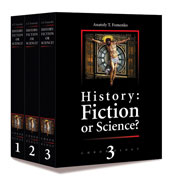
This book shall change your entire perception of history! What if Ancient Rome, Greece and Egypt were invented during Renaissance? What if Old Testament was a rendition of events of Middle Ages and was written well after the Gospels? What if Jesus Christ was born in 1053 and crucified in 1086 AD?
Sounds unbelievable? Not after you've read "History: Fiction or Science?" by Anatoly Fomenko, leading mathematician of our time. He follows in steps of Sir Isaac Newton and finds clear evidence of falsification of History. Armed with logic, astronomy and computers he proves the history of humankind to be both dramatically different and drastically shorter than generally presumed.
Archaeological, dendrochronological, paleographical and carbon methods of dating of ancient sources and artifacts are both non-exact and contradictory, therefore there is not a single piece of firm written evidence or artifact that could be reliably and independently dated earlier than the XI century.
The consensual chronology we live with was essentially crafted in the XVI century from the contradictory mix of innumerable copies of ancient Latin and Greek manuscripts (all originals have mysteriously disappeared) and the "proofs" delivered by the late mediaeval astronomers, cemented by the authority of writings of the Church Fathers.
In fact, for the last 300 years, the whole class of historians created, researched, perfected and polished a world of phantom universal history and classical civilization artfully constructed by their predecessors in the course of XVI-XVIII centuries at the command of powers of that time. They have polished the real world history into oblivion!
"History:Fiction or Science?", supplies You with sufficient proof to reach step by step for yourself the inevitable conclusion that the classical chronology is false and therefore, that the history of ancient and medieval world, is also FALSE. After reading this book you will certainly have a fresh and very suspicious outlook on "ancient" and "enigmatic" Roman, Greek and Egyptian, mediaeval as well as all other "lost and found" civilizations.
This book crowns over 30 of meticulous and extensive research.
Henry Ford once said: "History is more or less bunk!"
Prominent mathematician Anatoly Fomenko proves it.
Contents
Chapter 1 The problems of historical chronology
1. Roman chronology as the foundation of European chronology
2. Scaliger, Petavius, and other clerical chronologers.
The creation of contemporary chronology of the ancient times in the XVI-XVII century a.d.
3. The veracity of the Scaliger-Petavius chronology was questioned as early as the XVI century
3.1. Who criticized Scaliger's chronology and where.
3.1.1. De Arcilla, Robert Baldauf, Jean Hardouin, Edwin Johnson, Wilhelm Kammeyer
3.1.2. Sir Isaac Newton
3.1.3. Nikolai Alexandrovich Morozov
3.1.4. Recent publications of German scientists containing criticisms of Scaliger's chronologY.
3.2. The questionnable veracity of the Roman chronology and history.
The hypercritical school of the XIX century
4. The problems in establishing a correct chronology of "ancient" Egypt
5. The problem in dating the "ancient" sources.Tacitus and Poggio
Cicero and Barzizza. Vitruvius and Alberti
6. Timekeeping in the Middle Ages. Historians discuss the "chaos reigning
in the mediaeval datings."
Peculiar mediaeval anachronisms
7. The chronology and the dating of Biblical texts
8. Difficulties and contradictions arising from the reading of old texts
8.1. How does one read a text written in consonants exclusively? The vocalization problem
9. Problems in the Scaligerian geography of Biblical events
9.1. Archaeology and the Old Testament
9.2. Archaeology and the New Testament
10. Ancient historical events: geographic localization issues
10.1. The locations of Troy and Babylon.
13.3. The alleged acceleration of the destruction of the "ancient" monuments
10.2. The geography of Herodotus is at odds with the Scaligerian version
10.3. The inverted maps of the Middle Ages
11. A modern analysis of Biblical geography
12. The mysterious Renaissance epoch as a product of the Scaligerian chronology
13. The foundations of archaeological methods have been based
on the Scaligerian
chronology from the very beginning
13.4. When did the construction of the Cologne Cathedral really begin?
13.5. Archaeological methods are most often based on Scaliger's datings
13.6. One of the numerous problems of the Scaligerian history
the problem
of bronze manufacture before the discovery of tin.
14. The problems and deficiencies of dendrochronology and several other dating methods
14.1. The consequent scale of dendrochronological datings does not extend
further back in time than the X century a.d.
14.2. Sedimentary layer datings. The methods of radium-uranium and radium-actinium analysis
15. Are radiocarbon datings to be trusted?
15.1. The radiocarbon datings of ancient, mediaeval, and modern specimens are scattered chaotically
15.1.1. Libby's initial idea. The first failures
15.1.2. A criticism of the application of the radiocarbon method to historical specimens
15.2. The dating of the Shroud of Turin
15.3 Modern radiocarbon analysis of Egyptian artefacts demonstrates serious contradictions
16. Critical analysis of the hypotheses on which the radiocarbon method is based. By A. S. Mishchenko
16.1. W. F. Libby's initial idea
16.2. Physical basics of the radiocarbon method
16.3. The hypotheses that the radiocarbon method is based upon
16.4. The moment of the object's departure from the exchange reservoir
16.5. Radiocarbon content variations in the exchange reservoir
16.6. Variations in radiocarbon content of living bodies
18. Numismatic datings
Chapter 2 Astronomical datings
1. The strange leap of parameter D" in the Theory of Lunar Motion
2. Are the "ancient" and mediaeval eclipses dated correctly?
2.1. Some astronomical data
2.2. The discovery of an interesting effect: an unprejudiced astronomical dating
shifts the dates of the "ancient" eclipses to the Middle Ages
2.3. Three eclipses described by the "ancient" Thucydides
2.4. The eclipses described by the "ancient" Titus Livy
3. Transferring the dates of the "ancient" eclipses forward in time into
the Middle Ages
eliminates the enigmatic behaviour of the parameter D".
4. Astronomy moves the "ancient" horoscopes into the Middle Ages
4.1. The mediaeval astronomy
4.2. The method of unprejudiced astronomical dating
4.3. Many "ancient astronomical observations" may have been theoretically
calculated
by late mediaeval astronomers and then included into the "ancient"
chronicles as "real observations"
4.4. Which astronomical "observations of the ancients" could have been
a result
of late mediaeval theoretic calculations?
5. A brief account of several examples of Egyptian Zodiacs
5.1. Some general observations
5.2. The Dendera Zodiacs
5.3. The horoscopes of Brugsch and Flinders Petrie
5.4. Finite datings of the Egyptian Zodiacs based on their complete deciphering,
as obtained by A. T. Fomenko and G. V. Nosovskiy in 2001
5.5. On the errors of E. S. Goloubtsova and Y. A. Zavenyagin 6. Astronomy in the New Testament
Chapter 3 The new dating of the astronomical horoscope as described in the Apocalypse
By A. T. Fomenko and G. V. Nosovskiy
1. The proposed research method
2. General information about the Apocalypse and the time of its creation
3. Ursa Major and the throne
4. The events took place on the Isle of Patmos
5. The constellations of Cassiopeia and the throne were drawn as Christ
sitting on his throne in the Middle Ages
6. The Milky Way
7. Twenty-four sidereal hours and the constellation of the Northern Crown
8. Leo, Taurus, Sagittarius, Pegasus
9. The daily rotation of the Northern Crown
10. Equine planetary images in mediaeval astronomy
11. Jupiter is in Sagittarius
12. Mars is beneath Perseus in either Gemini or Taurus
13. Mercury is in Libra
14. Saturn is in Scorpio
15. The Sun is in Virgo with the Moon underneath the feet of the latter
16. Venus is in Leo
17. The astronomical dating of the Apocalypse by the horoscope it contains
18. Our reconstruction of the initial content of the Apocalypse
Chapter 4 Astronomy in the Old Testament
1. Mediaeval astronomy in the Old Testament Book of Ezekiel
1.1. The title of the book
1.2. The description of the Milky Way and the Ophiuchus constellation
1.3. The Biblical description of the astronomical sectors, or "wings," on the celestial sphere
1.4. The constellations of Leo, Taurus and Aquila
1.5. The Biblical description of the mediaeval "wheels," or planetary orbits
1.6. Parallels with the astronomical symbolism of the Apocalypse
1.7. Biblical cherubim, chariots, and mediaeval planetary orbital wheels
1.8. The Biblical description of mediaeval cosmology as a celestial temple
2. The Biblical prophecy of Zechariah and the date of its creation
3. The Biblical prophecy of Jeremiah and the date of its creation
4. The Biblical prophecy of Isaiah and the date of its creation
5. The Biblical prophecy of Daniel and the date of its creation
Chapter 5 The methods of dating the ancient events offered by mathematical statistics
1. The local maxima method
1.1. The historical text volume function
1.2. The maxima correlation principle
1.3. Statistical model
1.4. Experimental test of the maxima correlation principle.
Examples of dependent and independent historical texts
1.5. Method of dating the historical events
2. Volume functions of historical texts and the amplitude correlation principle.
By A. T. Fomenko and S. T. Rachev
2.1. Dependent and independent chronicles. Volume function maxima correlletions
2.2. Rich and poor chronicles and chronicle zones
2.3. Significant and insignificant zeroes of volume functions
2.4. The information respect principles
2.5. The amplitude correlation principle of volume graphs in the poor zones of chronicles
2.6. Description of statistical model and formalization
2.7. The hypothesis about the increase of the "form" parameter of a chronicle in the course of times
2.8. The list and characteristics of the Russian chronicles we investigated
2.9. The final table of the numeric experiment
2.10. Interesting consequences of the numeric experiment.
The confirmation of the statistical model
2.11. Comparison of a priori dependent Russian chronicles
2.12. Comparison of a priori independent Russian chronicles
2.13. Growth of form parameter in the course of time
for the Russian chronicles after the XIII century
2.14. Growth of the average form parameter over the course of time
for groups
of Russian chronicles of the XIII-XVI century
2.15. Growth of the average parameter of form over the course of time
for the groups
of Russian chronicles of the alleged IX-XIII century
2.16. Chronological shift by 300 or 400 years in Russian history
2.17. Conclusions
3. The maxima correlation principle on the material of the sources pertinent
to
the epoch of Strife in the History of Russia (1584-1619)
By A. T. Fomenko, N. S. Kellin and L. E. Morozova
4. The method for the recognition and dating of the dynasties of rulers.
The small dynastic distortions principle
4.1. The formulation of the small dynastic distortions principle
4.2. The statistical model
4.3. Refinement of the model and the computation experimens
4.4. Result of the experiment: coefficient c(a, b) positively distinguishes
between the dependent and independent dynasties of kings
4.5. The method of dating the royal dynasties and the method
detecting the phantom dynastic duplicates
5. The frequency damping principle.The method of ordering of historical texts in time
6. Application of the method to some concrete historical texts
7. Method of dating of the events
8. The frequencies duplication principle. The duplicate detection method
9. Statistical analysis of the Bible
9.1. Partition of the Bible into 218 "generation chapters"
9.2. Detection of the previously known duplicates in the Bible
with the aid of the frequency dumping principle
9.3. New, previously unknown duplicates we discovered in the Bible.
General scheme of their distribution within the Bible
9.4. A representative example: the new statistical dating of the Apocalypse,
which moves from the New Testament into the Old Testament
10. The method of form-codes. The comparison of two long currents of regal biographies
11. Correct chronological ordering method and dating of ancient geographical maps
Chapter 6 The construction of a global chronological map and the results of applying
mathematical procedures of dating to the Scaligerian version of the ancient history
1. Textbook of ancient and mediaeval history in the consensual Scaliger-Petavius datings
2. Mysterious duplicate chronicles inside the "Scaliger-Petavius textbook"
3. Mysterious duplicate regal dynasties inside the "textbook by Scaliger-Petavius"
4. Brief tables of some astonishing dynastic parallelisms
5. Conformity of results obtained by different methods
5.1. General assertion
5.2. The agreement of the different methods on the example of the identification
of the Biblical Judaic reign with the Holy Roman Empire of allegedly X-XIII century a.d.
6. The general layout of duplicates in "the textbook by Scaliger-Petavius".
The discovery of the three basic chronological shifts
7. The Scaligerian textbook of the ancient history glued together
four duplicates of the short original chronicle
8. The list of phantom "ancient" events which are phantom duplicates,
or reflections of the mediaeval originals
9. Identification of the "ancient" Biblical history with the mediaeval European history
10. Our hypothesis: history as described in surviving chronicles only begins in ca. the X century a.d.
We know nothing of the events that took place before the X century a.d.
11. Authentic history only begins in XVII century a.d.
The history of the XI-XVI century is largely distorted.
Many dates of the XI-XVI century require correction
12. The radical distinction of our chronological concept from the version of N. A. Morozov
13. The hypothesis about the cause of the fallacious chronological
shifts
in the creation of the history of antiquity
13.1. Chronological shift of a thousand years as the consequence of the fallacious dating of Jesus Christ's life
13.2. The letter "X" formerly denoted the name of Christ,
but was later proclaimed to stand for the figure of ten.
The letter "I" formerly denoted the name of Jesus, but
was later proclaimed to be the indication of one thousand
13.3. Until the XVIII century, the Latin letters "I" or "J" - i.e. the
first letters of the name of Jesus -
were still used in several
European regions to denote "one" in recording of dates
13.4. How the chronological shift by 330 or 360 years could have occured
13.5. What latin letters "M", "D", "C" in Roman dates meant originally, in the Middle Ages
13.5.1. General idea
13.5.2. Example: the date on the tomb of Empress Gisela
13.5.3. Another example: the date on the headstone of Emperor Rudolf Habsburg
13.5.4. Recording of mediaeval dates was not unified everywhere even in the XVIII century
13.5.5. Some datings of printed books and manuscripts dating
from the XV-XVII century
will apparently have to be moved
forwards in time by at least fifty more years
13.6. The foundation date of Rome of Italy
13.7. A later confusion of foundation dates of the two Romes,
on the Bosporus and in Italy.
13.8. Scaliger and the Council of Trent. Creation of the Scaligerian
chronology
of antiquity in the XVI-XVII century
13.9. Two phantom "ancient" reflections of Dionysius Petavius,
a mediaeval chronologist of the XVII century
14. A stratified structure of the Scaligerian textbook of ancient history
15. The coordination of a new astronomical dating with a dynastic parallel
16. A strange lapse in the Scaligerian chronology near "the beginning of the new era"
Chapter 7 "Dark Ages" in mediaeval history
1. The mysterious Renaissance of the "Classical Age" in mediaeval Rome
1.1. The lugubrious "Dark Ages" in Europe that presumably succeeded
the beauteous "Classical Age"
1.2. Parallels between "antiquity" and the Middle Ages that are known
to historians, but misinterpreted by them
1.3. Mediaeval Roman legislators convene in the presumably destroyed "ancient" Capitol
1.4. The real date when the famous "ancient" statue of Marcus Aurelius
was manufactured
1.5. Could the "ancient" Emperor Vitellius have posed for the mediaeval
artist Tintoretto?
1.6. The amount of time required for the manufacture of one sheet of parchment
1.7. The "ancient" Roman Emperor Augustus had been Christian, since
he wore a mediaeval crown with a Christian cross
2. The "ancient" historian Tacitus and the well-known Renaissance writer Poggio Bracciolini
3. The mediaeval Western European Christian cult and the "ancient" pagan
Bacchic celebrations
4. Petrarch (= Plutarch?) and the "Renaissance of antiquity"
4.1. How Petrarch created the legend of the glory of Italian Rome out of nothing
4.2. Petrarch's private correspondence with people considered
"ancient characters" nowadays
5. "Ancient" Greece and mediaeval Greece of the XIII-XVI century
5.1. The history of the mediaeval Athens is supposed to be obscured by darkness
up until the XVI century
5.2. Greece and the Crusades
5.3. The history of Greek and Athenian archaeology is relatively short
5.4. The tendentious distortion of the image of mediaeval Athens in
the "restoration works"
of the XIX-XX century
6. Strange parallels in the Scaligerian history of religions
6.1. Mediaeval Christianity and its reflection in the Scaligerian "pagan antiquity"
6.2. Mediaeval Christianity and "ancient" Mithraism
6.3. References to Jesus Christ contained in "ancient" Egyptian artefacts
6.4. Researchers of the ancient religions commenting on the strange similarities
between the cults of "antiquity" and those of the Middle Ages
6.5. Moses, Aaron and their sister Virgin Mary on the pages of the Koran
6.6. The XI century as the apparent epoch of St. Mark's lifetime.
The history of St. Mark's Cathedral in Venice
7. The "ancient" Egypt and the Middle Ages
7.1. The odd graph of demotic text datings
7.2. The enigmatic "revival periods" in the history of "ancient" Egypt
7.3. The ancient Hittites and the mediaeval Goths
8. Problems inherent in the Scaligerian chronology of India
9. Was the artificial elongation of ancient history deliberate?
Annexes
2.1. (to chapter 2) Grammatical analysis of an eclipse description
in History by Thucydides. By Y. V. 471
5.1. (to chapter 5) Per annum volume distribution in some Russian chronicles
5.2. (to chapter 5) Frequency matrix of names and parallels in the Bible
By V. P. Fomenko and T. G. Fomenko
6.1. (to chapter 6) Per annum volume distribution in The History of the City
of Rome
in the Middle Ages by F. Gregorovius
6.2. (to chapter 6) Per annum volume distribution in The Roman History
from
the Foundation of the City by Titus Livy
6.3. (to chapter 6) Per annum volume distribution in the book by Baronius
describing mediaeval Rome
6.4. (to chapter 6) The "double entry" of the Biblical royal reigns of Israel and Judah
6.5. (to chapter 6) Armenian history. Emperors of the Holy Roman Empire
of the alleged X-XIII century a.d., a.k.a. the Kings of Judah, a.k.a. the
mediaeval Armenian Catholicoses
1. Three phantom reflections of the same mediaeval dynasty
2. The parallelism between the mediaeval Armenian history
and the phantom Roman Empire according to Scaliges
6.6. (to chapter 6) The identification of the "ancient" Kingdom of Judah
with the Holy Roman Empire of the alleged X-XIII century a.d.
The correlation between reign durations and biographical volumes
Age of Fable: Stories of Gods and Heroes
Thomas Bulfinch (1796-1867)
Roman Divinities
Part X
PERSEUS AND ATLAS
After the slaughter of Medusa, Perseus, bearing with him the head of the Gorgon, flew far and wide, over land and sea. As night came on, he reached the western limit of the earth, where the sun goes down. Here he would gladly have rested till morning. It was the realm of King Atlas, whose bulk surpassed that of all other men. He was rich iii flocks and herds and had no neighbour or rival to dispute his state. But his chief pride was in his gardens whose fruit was of gold, hanging from golden branches, half hid with golden leaves. Perseus said to him, "I come as a guest. If you honour illustrious descent, I claim Jupiter for my father; if mighty deeds, I plead the conquest of the Gorgon. I seek rest and food." But Atlas remembered that an ancient prophecy had warned him that a son of Jove should one day rob him of His golden apples. So he answered, "Begone! or neither your false claims of glory nor parentage shall protect you;" and he attempted to thrust him out. Perseus, finding the giant too strong for him, said, "Since you value my friendship so little, deign to accept a present;" and turning his face away, he held up the Gorgon's head. Atlas, with all his bulk, was changed into stone. His beard and hair became forests, his arms and shoulders cliffs, his head a summit, and his bones rocks. Each part increased in bulk till be became a mountain, and (such was the pleasure of the gods) heaven with all its stars rests upon his shoulders.
THE SEA-MONSTER
Perseus, continuing his flight, arrived at the country of the AEthiopians, of which Cepheus was king. Cassiopeia his queen, proud of her beauty, had dared to compare herself to the Sea-nymphs, which roused their indignation to such a degree that they sent a prodigious sea-monster to ravage the coast. To appease the deities, Cepheus was directed by the oracle to expose his daughter Andromeda to be devoured by the monster. As Perseus looked down from his aerial height he beheld the virgin chained to a rock, and waiting the approach of the serpent. She was so pale and motionless that if it had not been for her flowing tears and her hair that moved in the breeze, he would have taken her for a marble statue. He was so startled at the sight that he almost forgot to wave his wings. As he hovered over her he said, "O virgin, undeserving of those chains, but rather of such as bind fond lovers together, tell me, I beseech you, your name, and the name of your country, and why you are thus bound." At first she was silent from modesty, and, if she could, would have hid her face with her hands; but when he repeated his questions, for fear she might be thought guilty of some fault which she dared not tell, she disclosed her name And that of her country, and her mother's pride of beauty. Before she had done speaking, a sound was heard off upon the water, and the sea-monster appeared, with his head raised above the surface, cleaving the waves with his broad breast. The virgin shrieked, the father and mother who had now arrived at the scene, wretched both, but the mother more justly so, stood by, not able to afford protection, but only to pour forth lamentations and to embrace the victim. Then spoke Perseus; "There will be time enough for tears; this hour is all we have for rescue. My rank as the son of Jove and my renown as the slayer of the Gorgon might make me acceptable as a suitor; but I will try to win her by services rendered, if the gods will only be propitious. If she be rescued by my valour, I demand that she be my reward." The parents consent (how could they hesitate?) and promise a royal dowry with her.
And now the monster was within the range of a stone thrown by a skilful slinger, when with a sudden bound the youth soared into the air. As an eagle, when from his lofty flight he sees a serpent basking in the sun, pounces upon him and seizes him by the neck to prevent him from turning his head round and using his fangs, so the youth darted down upon the back of the monster and plunged his sword into its shoulder. Irritated by the wound, the monster raised himself into the air, then plunged into the depth; then, like a wild boar surrounded by a pack of barking dogs, turned swiftly from side to side, while the youth eluded its attacks by means of his wings. Wherever he can find a passage for his sword between the scales he makes a wound, piercing now the side, now the flank, as it slopes towards the tail. The brute spouts from his nostrils water mixed with blood. The wings of the hero are wet with it, and he dares no longer trust to them. Alighting on a rock which rose above the waves, and holding on by a projecting fragment, as the monster floated near he gave him a death stroke. The people who had gathered on the shore shouted so that the hills reechoed with the sound. The parents, transported with joy, embraced their future son-in-law, calling him their deliverer and the saviour of their house, and the virgin, both cause and reward of the contest, descended from the rock.
Cassiopeia was an AEthiopian, and consequently, in spite of her boasted beauty, black; at least so Milton seems to have thought, who alludes to this story in his "Penseroso," where he addresses Melancholy as the
"...goddess, sage and holy,
Whose saintly visage is too bright
To hit the sense of human sight,
And, therefore, to our weaker view,
O'erlaid with black, staid Wisdom's hue.
Black, but such as in esteem
Prince Memnon's sister might beseem.
Or that starred AEthiop queen that strove
To set her beauty's praise above
The sea-nymphs, and their powers offended."
Cassiopeia is called "the starred AEthiop, queen" because after her death she was placed among the stars, forming the constellation of that name. Though she attained this honour, yet the Sea-Nymphs, her old enemies, prevailed so far as to cause her to be placed in that part of the heaven near the pole, where every night she is half the time held with her head downward, to give her a lesson of humility.
Memnon was an AEthiopian prince, of whom we shall tell in a future chapter.
THE WEDDING FEAST
The joyful parents, with Perseus and Andromeda, repaired to the palace, where a banquet was spread for them, and all was joy and festivity. But suddenly a noise was heard of warlike clamour, and Phineus, the betrothed of the virgin, with a party of his adherents, burst in, demanding the maiden as his own. It was in vain that Cepheus remonstrated- "You should have claimed her when she lay bound to the rock, the monster's victim. The sentence of the gods dooming her to such a fate dissolved all engagements, as death itself would have done." Phineus made no reply, but hurled his javelin at Perseus, but it missed its mark and fell harmless. Perseus would have thrown his in turn, but the cowardly assailant ran and took shelter behind the altar. But his act was a signal for an onset by his hand upon the guests of Cepheus. They defended themselves and a general conflict ensued, the old king retreating from the scene after fruitless expostulations, calling the gods to witness that he was guiltless of this outrage on the rights of hospitality.
Perseus and his friends maintained for some time the unequal contest; but the numbers of the assailants were too great for them, and destruction seemed inevitable, when a sudden thought struck Perseus,- "I will make my enemy defend me." Then with a loud voice he exclaimed, "If I have any friend here let him turn away his eyes!" and held aloft the Gorgon's head. "Seek not to frighten us with your jugglery," said Thescelus, and raised his javelin in the act to throw, and became stone in the very attitude. Ampyx was about to plunge his sword into the body of a prostrate foe, but his arm stiffened and he could neither thrust forward nor withdraw it. Another, in the midst of a vociferous challenge, stopped, his mouth open, but no sound issuing. One of Perseus's friends, Aconteus, caught sight of the Gorgon and stiffened like the rest. Astyages struck him with his sword, but instead of wounding, it recoiled with a ringing noise.
Phineus beheld this dreadful result of his unjust aggression, and felt confounded. He called aloud to his friends, but got no answer; he touched them and found them stone. Falling on his knees and stretching out his hands to Perseus, but turning his head away, he begged for mercy. "Take all," said he, "give me but my life." "Base coward," said Perseus, "thus much I will grant you; no weapon shall touch you; moreover, you shall be preserved in my house as a memorial of these events." So saying, he held the Gorgon's head to the side where Phineus was looking, and in the very form which he knelt, with his hands outstretched and face averted, he became fixed immovably, a mass of stone!
The following allusion to Perseus is from Milman's "Samor":
"As 'mid the fabled Libyan bridal stood
Perseus in stern tranquillity of wrath,
Half stood, half floated on his ankle-plumes
Out-swelling, while the bright face on his shield
Looked into stone the raging fray; so rose,
But with no magic arms, wearing alone
Th' appalling and control of his firm look,
The Briton Samor; at his rising awe
Went abroad, and the riotous hall was mute."