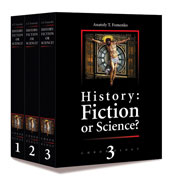
This book shall change your entire perception of history! What if Ancient Rome, Greece and Egypt were invented during Renaissance? What if Old Testament was a rendition of events of Middle Ages and was written well after the Gospels? What if Jesus Christ was born in 1053 and crucified in 1086 AD?
Sounds unbelievable? Not after you've read "History: Fiction or Science?" by Anatoly Fomenko, leading mathematician of our time. He follows in steps of Sir Isaac Newton and finds clear evidence of falsification of History. Armed with logic, astronomy and computers he proves the history of humankind to be both dramatically different and drastically shorter than generally presumed.
Archaeological, dendrochronological, paleographical and carbon methods of dating of ancient sources and artifacts are both non-exact and contradictory, therefore there is not a single piece of firm written evidence or artifact that could be reliably and independently dated earlier than the XI century.
The consensual chronology we live with was essentially crafted in the XVI century from the contradictory mix of innumerable copies of ancient Latin and Greek manuscripts (all originals have mysteriously disappeared) and the "proofs" delivered by the late mediaeval astronomers, cemented by the authority of writings of the Church Fathers.
In fact, for the last 300 years, the whole class of historians created, researched, perfected and polished a world of phantom universal history and classical civilization artfully constructed by their predecessors in the course of XVI-XVIII centuries at the command of powers of that time. They have polished the real world history into oblivion!
"History:Fiction or Science?", supplies You with sufficient proof to reach step by step for yourself the inevitable conclusion that the classical chronology is false and therefore, that the history of ancient and medieval world, is also FALSE. After reading this book you will certainly have a fresh and very suspicious outlook on "ancient" and "enigmatic" Roman, Greek and Egyptian, mediaeval as well as all other "lost and found" civilizations.
This book crowns over 30 of meticulous and extensive research.
Henry Ford once said: "History is more or less bunk!"
Prominent mathematician Anatoly Fomenko proves it.
Contents
Chapter 1 The problems of historical chronology
1. Roman chronology as the foundation of European chronology
2. Scaliger, Petavius, and other clerical chronologers.
The creation of contemporary chronology of the ancient times in the XVI-XVII century a.d.
3. The veracity of the Scaliger-Petavius chronology was questioned as early as the XVI century
3.1. Who criticized Scaliger's chronology and where.
3.1.1. De Arcilla, Robert Baldauf, Jean Hardouin, Edwin Johnson, Wilhelm Kammeyer
3.1.2. Sir Isaac Newton
3.1.3. Nikolai Alexandrovich Morozov
3.1.4. Recent publications of German scientists containing criticisms of Scaliger's chronologY.
3.2. The questionnable veracity of the Roman chronology and history.
The hypercritical school of the XIX century
4. The problems in establishing a correct chronology of "ancient" Egypt
5. The problem in dating the "ancient" sources.Tacitus and Poggio
Cicero and Barzizza. Vitruvius and Alberti
6. Timekeeping in the Middle Ages. Historians discuss the "chaos reigning
in the mediaeval datings."
Peculiar mediaeval anachronisms
7. The chronology and the dating of Biblical texts
8. Difficulties and contradictions arising from the reading of old texts
8.1. How does one read a text written in consonants exclusively? The vocalization problem
9. Problems in the Scaligerian geography of Biblical events
9.1. Archaeology and the Old Testament
9.2. Archaeology and the New Testament
10. Ancient historical events: geographic localization issues
10.1. The locations of Troy and Babylon.
13.3. The alleged acceleration of the destruction of the "ancient" monuments
10.2. The geography of Herodotus is at odds with the Scaligerian version
10.3. The inverted maps of the Middle Ages
11. A modern analysis of Biblical geography
12. The mysterious Renaissance epoch as a product of the Scaligerian chronology
13. The foundations of archaeological methods have been based
on the Scaligerian
chronology from the very beginning
13.4. When did the construction of the Cologne Cathedral really begin?
13.5. Archaeological methods are most often based on Scaliger's datings
13.6. One of the numerous problems of the Scaligerian history
the problem
of bronze manufacture before the discovery of tin.
14. The problems and deficiencies of dendrochronology and several other dating methods
14.1. The consequent scale of dendrochronological datings does not extend
further back in time than the X century a.d.
14.2. Sedimentary layer datings. The methods of radium-uranium and radium-actinium analysis
15. Are radiocarbon datings to be trusted?
15.1. The radiocarbon datings of ancient, mediaeval, and modern specimens are scattered chaotically
15.1.1. Libby's initial idea. The first failures
15.1.2. A criticism of the application of the radiocarbon method to historical specimens
15.2. The dating of the Shroud of Turin
15.3 Modern radiocarbon analysis of Egyptian artefacts demonstrates serious contradictions
16. Critical analysis of the hypotheses on which the radiocarbon method is based. By A. S. Mishchenko
16.1. W. F. Libby's initial idea
16.2. Physical basics of the radiocarbon method
16.3. The hypotheses that the radiocarbon method is based upon
16.4. The moment of the object's departure from the exchange reservoir
16.5. Radiocarbon content variations in the exchange reservoir
16.6. Variations in radiocarbon content of living bodies
18. Numismatic datings
Chapter 2 Astronomical datings
1. The strange leap of parameter D" in the Theory of Lunar Motion
2. Are the "ancient" and mediaeval eclipses dated correctly?
2.1. Some astronomical data
2.2. The discovery of an interesting effect: an unprejudiced astronomical dating
shifts the dates of the "ancient" eclipses to the Middle Ages
2.3. Three eclipses described by the "ancient" Thucydides
2.4. The eclipses described by the "ancient" Titus Livy
3. Transferring the dates of the "ancient" eclipses forward in time into
the Middle Ages
eliminates the enigmatic behaviour of the parameter D".
4. Astronomy moves the "ancient" horoscopes into the Middle Ages
4.1. The mediaeval astronomy
4.2. The method of unprejudiced astronomical dating
4.3. Many "ancient astronomical observations" may have been theoretically
calculated
by late mediaeval astronomers and then included into the "ancient"
chronicles as "real observations"
4.4. Which astronomical "observations of the ancients" could have been
a result
of late mediaeval theoretic calculations?
5. A brief account of several examples of Egyptian Zodiacs
5.1. Some general observations
5.2. The Dendera Zodiacs
5.3. The horoscopes of Brugsch and Flinders Petrie
5.4. Finite datings of the Egyptian Zodiacs based on their complete deciphering,
as obtained by A. T. Fomenko and G. V. Nosovskiy in 2001
5.5. On the errors of E. S. Goloubtsova and Y. A. Zavenyagin 6. Astronomy in the New Testament
Chapter 3 The new dating of the astronomical horoscope as described in the Apocalypse
By A. T. Fomenko and G. V. Nosovskiy
1. The proposed research method
2. General information about the Apocalypse and the time of its creation
3. Ursa Major and the throne
4. The events took place on the Isle of Patmos
5. The constellations of Cassiopeia and the throne were drawn as Christ
sitting on his throne in the Middle Ages
6. The Milky Way
7. Twenty-four sidereal hours and the constellation of the Northern Crown
8. Leo, Taurus, Sagittarius, Pegasus
9. The daily rotation of the Northern Crown
10. Equine planetary images in mediaeval astronomy
11. Jupiter is in Sagittarius
12. Mars is beneath Perseus in either Gemini or Taurus
13. Mercury is in Libra
14. Saturn is in Scorpio
15. The Sun is in Virgo with the Moon underneath the feet of the latter
16. Venus is in Leo
17. The astronomical dating of the Apocalypse by the horoscope it contains
18. Our reconstruction of the initial content of the Apocalypse
Chapter 4 Astronomy in the Old Testament
1. Mediaeval astronomy in the Old Testament Book of Ezekiel
1.1. The title of the book
1.2. The description of the Milky Way and the Ophiuchus constellation
1.3. The Biblical description of the astronomical sectors, or "wings," on the celestial sphere
1.4. The constellations of Leo, Taurus and Aquila
1.5. The Biblical description of the mediaeval "wheels," or planetary orbits
1.6. Parallels with the astronomical symbolism of the Apocalypse
1.7. Biblical cherubim, chariots, and mediaeval planetary orbital wheels
1.8. The Biblical description of mediaeval cosmology as a celestial temple
2. The Biblical prophecy of Zechariah and the date of its creation
3. The Biblical prophecy of Jeremiah and the date of its creation
4. The Biblical prophecy of Isaiah and the date of its creation
5. The Biblical prophecy of Daniel and the date of its creation
Chapter 5 The methods of dating the ancient events offered by mathematical statistics
1. The local maxima method
1.1. The historical text volume function
1.2. The maxima correlation principle
1.3. Statistical model
1.4. Experimental test of the maxima correlation principle.
Examples of dependent and independent historical texts
1.5. Method of dating the historical events
2. Volume functions of historical texts and the amplitude correlation principle.
By A. T. Fomenko and S. T. Rachev
2.1. Dependent and independent chronicles. Volume function maxima correlletions
2.2. Rich and poor chronicles and chronicle zones
2.3. Significant and insignificant zeroes of volume functions
2.4. The information respect principles
2.5. The amplitude correlation principle of volume graphs in the poor zones of chronicles
2.6. Description of statistical model and formalization
2.7. The hypothesis about the increase of the "form" parameter of a chronicle in the course of times
2.8. The list and characteristics of the Russian chronicles we investigated
2.9. The final table of the numeric experiment
2.10. Interesting consequences of the numeric experiment.
The confirmation of the statistical model
2.11. Comparison of a priori dependent Russian chronicles
2.12. Comparison of a priori independent Russian chronicles
2.13. Growth of form parameter in the course of time
for the Russian chronicles after the XIII century
2.14. Growth of the average form parameter over the course of time
for groups
of Russian chronicles of the XIII-XVI century
2.15. Growth of the average parameter of form over the course of time
for the groups
of Russian chronicles of the alleged IX-XIII century
2.16. Chronological shift by 300 or 400 years in Russian history
2.17. Conclusions
3. The maxima correlation principle on the material of the sources pertinent
to
the epoch of Strife in the History of Russia (1584-1619)
By A. T. Fomenko, N. S. Kellin and L. E. Morozova
4. The method for the recognition and dating of the dynasties of rulers.
The small dynastic distortions principle
4.1. The formulation of the small dynastic distortions principle
4.2. The statistical model
4.3. Refinement of the model and the computation experimens
4.4. Result of the experiment: coefficient c(a, b) positively distinguishes
between the dependent and independent dynasties of kings
4.5. The method of dating the royal dynasties and the method
detecting the phantom dynastic duplicates
5. The frequency damping principle.The method of ordering of historical texts in time
6. Application of the method to some concrete historical texts
7. Method of dating of the events
8. The frequencies duplication principle. The duplicate detection method
9. Statistical analysis of the Bible
9.1. Partition of the Bible into 218 "generation chapters"
9.2. Detection of the previously known duplicates in the Bible
with the aid of the frequency dumping principle
9.3. New, previously unknown duplicates we discovered in the Bible.
General scheme of their distribution within the Bible
9.4. A representative example: the new statistical dating of the Apocalypse,
which moves from the New Testament into the Old Testament
10. The method of form-codes. The comparison of two long currents of regal biographies
11. Correct chronological ordering method and dating of ancient geographical maps
Chapter 6 The construction of a global chronological map and the results of applying
mathematical procedures of dating to the Scaligerian version of the ancient history
1. Textbook of ancient and mediaeval history in the consensual Scaliger-Petavius datings
2. Mysterious duplicate chronicles inside the "Scaliger-Petavius textbook"
3. Mysterious duplicate regal dynasties inside the "textbook by Scaliger-Petavius"
4. Brief tables of some astonishing dynastic parallelisms
5. Conformity of results obtained by different methods
5.1. General assertion
5.2. The agreement of the different methods on the example of the identification
of the Biblical Judaic reign with the Holy Roman Empire of allegedly X-XIII century a.d.
6. The general layout of duplicates in "the textbook by Scaliger-Petavius".
The discovery of the three basic chronological shifts
7. The Scaligerian textbook of the ancient history glued together
four duplicates of the short original chronicle
8. The list of phantom "ancient" events which are phantom duplicates,
or reflections of the mediaeval originals
9. Identification of the "ancient" Biblical history with the mediaeval European history
10. Our hypothesis: history as described in surviving chronicles only begins in ca. the X century a.d.
We know nothing of the events that took place before the X century a.d.
11. Authentic history only begins in XVII century a.d.
The history of the XI-XVI century is largely distorted.
Many dates of the XI-XVI century require correction
12. The radical distinction of our chronological concept from the version of N. A. Morozov
13. The hypothesis about the cause of the fallacious chronological
shifts
in the creation of the history of antiquity
13.1. Chronological shift of a thousand years as the consequence of the fallacious dating of Jesus Christ's life
13.2. The letter "X" formerly denoted the name of Christ,
but was later proclaimed to stand for the figure of ten.
The letter "I" formerly denoted the name of Jesus, but
was later proclaimed to be the indication of one thousand
13.3. Until the XVIII century, the Latin letters "I" or "J" - i.e. the
first letters of the name of Jesus -
were still used in several
European regions to denote "one" in recording of dates
13.4. How the chronological shift by 330 or 360 years could have occured
13.5. What latin letters "M", "D", "C" in Roman dates meant originally, in the Middle Ages
13.5.1. General idea
13.5.2. Example: the date on the tomb of Empress Gisela
13.5.3. Another example: the date on the headstone of Emperor Rudolf Habsburg
13.5.4. Recording of mediaeval dates was not unified everywhere even in the XVIII century
13.5.5. Some datings of printed books and manuscripts dating
from the XV-XVII century
will apparently have to be moved
forwards in time by at least fifty more years
13.6. The foundation date of Rome of Italy
13.7. A later confusion of foundation dates of the two Romes,
on the Bosporus and in Italy.
13.8. Scaliger and the Council of Trent. Creation of the Scaligerian
chronology
of antiquity in the XVI-XVII century
13.9. Two phantom "ancient" reflections of Dionysius Petavius,
a mediaeval chronologist of the XVII century
14. A stratified structure of the Scaligerian textbook of ancient history
15. The coordination of a new astronomical dating with a dynastic parallel
16. A strange lapse in the Scaligerian chronology near "the beginning of the new era"
Chapter 7 "Dark Ages" in mediaeval history
1. The mysterious Renaissance of the "Classical Age" in mediaeval Rome
1.1. The lugubrious "Dark Ages" in Europe that presumably succeeded
the beauteous "Classical Age"
1.2. Parallels between "antiquity" and the Middle Ages that are known
to historians, but misinterpreted by them
1.3. Mediaeval Roman legislators convene in the presumably destroyed "ancient" Capitol
1.4. The real date when the famous "ancient" statue of Marcus Aurelius
was manufactured
1.5. Could the "ancient" Emperor Vitellius have posed for the mediaeval
artist Tintoretto?
1.6. The amount of time required for the manufacture of one sheet of parchment
1.7. The "ancient" Roman Emperor Augustus had been Christian, since
he wore a mediaeval crown with a Christian cross
2. The "ancient" historian Tacitus and the well-known Renaissance writer Poggio Bracciolini
3. The mediaeval Western European Christian cult and the "ancient" pagan
Bacchic celebrations
4. Petrarch (= Plutarch?) and the "Renaissance of antiquity"
4.1. How Petrarch created the legend of the glory of Italian Rome out of nothing
4.2. Petrarch's private correspondence with people considered
"ancient characters" nowadays
5. "Ancient" Greece and mediaeval Greece of the XIII-XVI century
5.1. The history of the mediaeval Athens is supposed to be obscured by darkness
up until the XVI century
5.2. Greece and the Crusades
5.3. The history of Greek and Athenian archaeology is relatively short
5.4. The tendentious distortion of the image of mediaeval Athens in
the "restoration works"
of the XIX-XX century
6. Strange parallels in the Scaligerian history of religions
6.1. Mediaeval Christianity and its reflection in the Scaligerian "pagan antiquity"
6.2. Mediaeval Christianity and "ancient" Mithraism
6.3. References to Jesus Christ contained in "ancient" Egyptian artefacts
6.4. Researchers of the ancient religions commenting on the strange similarities
between the cults of "antiquity" and those of the Middle Ages
6.5. Moses, Aaron and their sister Virgin Mary on the pages of the Koran
6.6. The XI century as the apparent epoch of St. Mark's lifetime.
The history of St. Mark's Cathedral in Venice
7. The "ancient" Egypt and the Middle Ages
7.1. The odd graph of demotic text datings
7.2. The enigmatic "revival periods" in the history of "ancient" Egypt
7.3. The ancient Hittites and the mediaeval Goths
8. Problems inherent in the Scaligerian chronology of India
9. Was the artificial elongation of ancient history deliberate?
Annexes
2.1. (to chapter 2) Grammatical analysis of an eclipse description
in History by Thucydides. By Y. V. 471
5.1. (to chapter 5) Per annum volume distribution in some Russian chronicles
5.2. (to chapter 5) Frequency matrix of names and parallels in the Bible
By V. P. Fomenko and T. G. Fomenko
6.1. (to chapter 6) Per annum volume distribution in The History of the City
of Rome
in the Middle Ages by F. Gregorovius
6.2. (to chapter 6) Per annum volume distribution in The Roman History
from
the Foundation of the City by Titus Livy
6.3. (to chapter 6) Per annum volume distribution in the book by Baronius
describing mediaeval Rome
6.4. (to chapter 6) The "double entry" of the Biblical royal reigns of Israel and Judah
6.5. (to chapter 6) Armenian history. Emperors of the Holy Roman Empire
of the alleged X-XIII century a.d., a.k.a. the Kings of Judah, a.k.a. the
mediaeval Armenian Catholicoses
1. Three phantom reflections of the same mediaeval dynasty
2. The parallelism between the mediaeval Armenian history
and the phantom Roman Empire according to Scaliges
6.6. (to chapter 6) The identification of the "ancient" Kingdom of Judah
with the Holy Roman Empire of the alleged X-XIII century a.d.
The correlation between reign durations and biographical volumes
Age of Fable: Stories of Gods and Heroes
Thomas Bulfinch (1796-1867)
Roman Divinities
Part II
THE SLIME with which the earth was covered by the waters of the flood produced an excessive fertility, which called forth every variety of production, both bad and good. Among the rest, Python, an enormous serpent, crept forth, the terror of the people, and lurked in the caves of Mount Parnassus. Apollo slew him with his arrows-weapons which he had not before used against any but feeble animals, hares, wild goats, and such game. In commemoration of this illustrious conquest he instituted the Pythian games, in which the victor in feats of strength, swiftness of foot, or in the chariot race was crowned with a wreath of beech leaves; for the laurel was not yet adopted by Apollo as his own tree.
The famous statue of Apollo called the Belvedere represents the god after this victory over the serpent Python. To this Byron alludes in his "Childe Harold," iv., 161:
"…The lord of the unerring bow,
The god of life, and poetry, and light,
The Sun, in human limbs arrayed, and brow
All radiant from his triumph in the fight.
The shaft has just been shot; the arrow bright
With an immortal's vengeance; in his eye
And nostril, beautiful disdain, and might
And majesty flash their full lightnings by,
Developing in that one glance the Deity."
APOLLO AND DAPHNE
DAPHNE was Apollo's first love. It was not brought about by accident, but by the malice of Cupid. Apollo saw the boy playing with his bow and arrows; and being himself elated with his recent victory over Python, he said to him, "What have you to do with warlike weapons, saucy boy? Leave them for hands worthy of them. Behold the conquest I have won by means of them over the vast serpent who stretched his poisonous body over acres of the plain! Be content with your torch, child, and kindle up your flames, as you call them, where you will, but presume not to meddle with my weapons." Venus's boy heard these words, and rejoined, "Your arrows may strike all things else, Apollo, but mine shall strike you." So saying, he took his stand on a rock of Parnassus, and drew from his quiver two arrows of different workmanship, one to excite love, the other to repel it. The former was of gold and sharp pointed, the latter blunt and tipped with lead. With the leaden shaft he struck the nymph Daphne, the daughter of the river god Peneus, and with the golden one Apollo, through the heart. Forthwith the god was seized with love for the maiden, and she abhorred the thought of loving. Her delight was in woodland sports and in the spoils of the chase. Many lovers sought her, but she spurned them all, ranging the woods, and taking no thought of Cupid nor of Hymen. Her father often said to her, "Daughter, you owe me a son-in-law; you owe me grandchildren." She, hating the thought of marriage as a crime, with her beautiful face tinged all over with blushes, threw her arms around her father's neck, and said, "Dearest father, grant me this favor, that I may always remain unmarried, like Diana." He consented, but at the same time said, "Your own face will forbid it."
Apollo loved her, and longed to obtain her; and he who gives oracles to all the world was not wise enough to look into his own fortunes. He saw her hair flung loose over her shoulders, and said, "If so charming in disorder, what would it be if arranged?" He saw her eyes bright as stars; he saw her lips, and was not satisfied with only seeing them. He admired her hands and arms, naked to the shoulder, and whatever was hidden from view he imagined more beautiful still. He followed her; she fled, swifter than the wind, and delayed not a moment at his entreaties. "Stay," said he, "daughter of Peneus; I am not a foe. Do not fly me as a lamb flies the wolf, or a dove the hawk. It is for love I pursue you. You make me miserable, for fear you should fall and hurt yourself on these stones, and I should be the cause. Pray run slower, and I will follow slower. I am no clown, no rude peasant. Jupiter is my father, and I am lord of Delphos and Tenedos, and know all things, present and future. I am the god of song and the lyre. My arrows fly true to the mark; but, alas! an arrow more fatal than mine has pierced my heart! I am the god of medicine, and know the virtues of all healing plants. Alas! I suffer a malady that no balm can cure!
The nymph continued her flight, and left his plea half uttered. And even as she fled she charmed him. The wind blew her garments, and her unbound hair streamed loose behind her. The god grew impatient to find his wooings thrown away, and, sped by Cupid, gained upon her in the race. It was like a hound pursuing a hare, with open jaws ready to seize, while the feebler animal darts forward, slipping from the very grasp. So flew the god and the virgin-he on the wings of love, and she on those of fear. The pursuer is the more rapid, however, and gains upon her, and his panting breath blows upon her hair. Her strength begins to fail, and, ready to sink, she calls upon her father, the river god: "Help me, Peneus! open the earth to enclose me, or change my form, which has brought me into this danger!" Scarcely had she spoken, when a stiffness seized all her limbs; her bosom began to be enclosed in a tender bark; her hair became leaves; her arms became branches; her foot stuck fast in the ground, as a root; her face became a tree-top, retaining nothing of its former self but its beauty. Apollo stood amazed. He touched the stem, and felt the flesh tremble under the new bark. He embraced the branches, and lavished kisses on the wood. The branches shrank from his lips. "Since you cannot be my wife," said he, "you shall assuredly be my tree. I will wear you for my crown; I will decorate with you my harp and my quiver; and when the great Roman conquerors lead up the triumphal pomp to the Capitol, you shall be woven into wreaths for their brows. And, as eternal youth is mine, you also shall be always green, and your leaf know no decay." The nymph, now changed into a Laurel tree, bowed its head in grateful acknowledgement.
That Apollo should be the god both of music and poetry will not appear strange, but that medicine should also be assigned to his province, may. The poet Armstrong, himself a physician, thus accounts for it:
"Music exalts each joy, allays each grief,
Expels diseases, softens every pain;
And hence the wise of ancient days adored
One power of physic, melody, and song."
The story of Apollo and Daphne is often alluded to by the poets. Waller applies it to the case of one whose amatory verses, though they did not soften the heart of his mistress, yet won for the poet wide-spread fame:
"Yet what he sung in his immortal strain,
Though unsuccessful, was not sung in vain.
All but the nymph that should redress his wrong,
Attend his passion and approve his song.
Like Phœbus thus, acquiring unsought praise,
He caught at love and filled his arms with bays."
The following stanza from Shelley's "Adonais" alludes to Byron's early quarrel with the reviewers:
"The herded wolves, bold only to pursue;
The obscene ravens, clamorous o'er the dead;
The vultures, to the conqueror's banner true,
Who feed where Desolation first has fed,
And whose wings rain contagion: how they fled,
When like Apollo, from his golden bow,
The Pythian of the age one arrow sped
And smiled! The spoilers tempt no second blow;
They fawn on the proud feet that spurn them as they go."
PYRAMUS AND THISBE
PYRAMUS was the handsomest youth, and Thisbe the fairest maiden, in all Babylonia, where Semiramis reigned. Their parents occupied adjoining houses; and neighborhood brought the young people together, and acquaintance ripened into love. They would gladly have married, but their parents forbade. One thing, however, they could not forbid-that love should glow with equal ardor in the bosoms of both. They conversed by signs and glances, and the fire burned more intensely for being covered up. In the wall that parted the two houses there was a crack, caused by some fault in the structure. No one had remarked it before, but the lovers discovered it. What will not love discover! It afforded a passage to the voice; and tender messages used to pass backward and forward through the gap. As they stood, Pyramus on this side, Thisbe on that, their breaths would mingle. "Cruel wall," they said, "why do you keep two lovers apart? But we will not be ungrateful. We owe you, we confess, the privilege of transmitting loving words to willing ears." Such words they uttered on different sides of the wall; and when night came and they must say farewell, they pressed their lips upon the wall, she on her side, he on his, as they could come no nearer.
Next morning, when Aurora had put out the stars, and the sun had melted the frost from the grass, they met at the accustomed spot. Then, after lamenting their hard fate, they agreed that next night, when all was still, they would slip away from watchful eyes, leave their dwellings and walk out into the fields; and to insure a meeting, repair to a well-known edifice standing without the city's bounds, called the Tomb of Ninus, and that the one who came first should await the other at the foot of a certain tree. It was a white mulberry tree, and stood near a cool spring. All was agreed on, and they waited impatiently for the sun to go down beneath the waters and night to rise up from them. Then cautiously Thisbe stole forth, unobserved by the family, her head covered with a veil, made her way to the monument and sat down under the tree. As she sat alone in the dim light of the evening she descried a lioness, her jaws reeking with recent slaughter, approaching the fountain to slake her thirst. Thisbe fled at the sight, and sought refuge in the hollow of a rock. As she fled she dropped her veil. The lioness after drinking at the spring turned to retreat to the woods, and seeing the veil on the ground, tossed and rent it with her bloody mouth.
Pyramus, having been delayed, now approached the place of meeting. He saw in the sand the footsteps of the lion, and the color fled from his cheeks at the sight. Presently he found the veil all rent and bloody. "O hapless girl," said he, "I have been the cause of thy death! Thou, more worthy of life than I, hast fallen the first victim. I will follow. I am the guilty cause, in tempting thee forth to a place of such peril, and not being myself on the spot to guard thee. Come forth, ye lions, from the rocks, and tear this guilty body with your teeth." He took up the veil, carried it with him to the appointed tree, and covered it with kisses and with tears. "My blood also shall stain your texture," said he, and drawing his sword plunged it into his heart. The blood spurted from the wound, and tinged the white mulberries of the tree all red; and sinking into the earth reached the roots, so that the red color mounted through the trunk to the fruit.
By this time Thisbe, still trembling with fear, yet wishing not to disappoint her lover, stepped cautiously forth, looking anxiously for the youth, eager to tell him the danger she had escaped. When she came to the spot and saw the changed color of the mulberries she doubted whether it was the same place. While she hesitated she saw the form of one struggling in the agonies of death. She started back, a shudder ran through her frame as a ripple on the face of the still water when a sudden breeze sweeps over it. But as soon as she recognized her lover, she screamed and beat her breast, embracing the lifeless body, pouring tears into its wounds, and imprinting kisses on the cold lips. "O Pyramus," she cried, "what has done this? Answer me, Pyramus; it is your own Thisbe that speaks. Hear me, dearest, and lift that drooping head!" At the name of Thisbe Pyramus opened his eyes, then closed them again. She saw her veil stained with blood and the scabbard empty of its sword. "Thy own hand has slain thee, and for my sake," she said. "I too can be brave for once, and my love is as strong as thine. I will follow thee in death, for I have been the cause; and death which alone could part us shall not prevent my joining thee. And ye, unhappy parents of us both, deny us, let one tomb contain us. And thou, tree, retain the marks of slaughter. Let thy berries still serve for memorials of our blood." So saying she plunged the sword into her breast. Her parents ratified her wish, the gods also ratified it. The two bodies were buried in one sepulchre, and the tree ever after brought forth purple berries, as it does to this day.
Moore, in the "Sylph's Ball," speaking of Davy's Safety Lamp, is reminded of the wall that separated Thisbe and her lover:
"O for that Lamp's metallic gauze,
That curtain of protecting wire,
Which Davy delicately draws
Around illicit, dangerous fire!
The wall he sets 'twixt Flame and Air,
(Like that which barred young Thisbe's bliss,)
Through whose small holes this dangerous pair
May see each other, but not kiss."
In Mickle's translation of the "Lusiad" occurs the following allusion to the story of Pyramus and Thisbe, and the metamorphosis of the mulberries. The poet is describing the Island of Love:
"… here each gift Pomona's hand bestows
In cultured garden, free uncultured flows,
The flavor sweeter and the hue more fair
Than e'er was fostered by the hand of care.
The cherry here in shining crimson glows,
And stained with lovers' blood, in pendent rows,
The mulberries o'erload the bending boughs."
If any of our young readers can be so hard-hearted as to enjoy a laugh at the expense of poor Pyramus and Thisbe, they may find an opportunity by turning to Shakspeare's play of the "Midsummer Night's Dream," where it is most amusingly burlesqued.
CEPHALUS AND PROCRIS
CEPHALUS was a beautiful youth and fond of manly sports. He would rise before the dawn to pursue the chase. Aurora saw him when she first looked forth, fell in love with him, and stole him away. But Cephalus was just married to a charming wife whom he devotedly loved. Her name was Procris. She was a favorite of Diana, the goddess of hunting, who had given her a dog which could outrun every rival, and a javelin which would never fail of its mark; and Procris gave these presents to her husband. Cephalus was so happy in his wife that he resisted all the entreaties of Aurora, and she finally dismissed him in displeasure, saying, "Go, ungrateful mortal, keep your wife, whom, if I am not much mistaken, you will one day be very sorry you ever saw again."
Cephalus returned, and was as happy as ever in his wife and his woodland sports. Now it happened some angry deity had sent a ravenous fox to annoy the country; and the hunters turned out in great strength to capture it. Their efforts were all in vain; no dog could run it down; and at last they came to Cephalus to borrow his famous dog, whose name was Lelaps. No sooner was the dog let loose than he darted off, quicker than their eye could follow him. If they had not seen his footprints in the sand they would have thought he flew. Cephalus and others stood on a hill and saw the race. The fox tried every art; he ran in a circle and turned on his track, the dog close upon him, with open jaws, snapping at his javelin, when suddenly he saw both dog and game stop instantly. The heavenly powers who had given both were not willing that either should conquer. In the very attitude of life and action they were turned into stone. So lifelike and natural did they look, you would have thought, as you looked at them, that one was going to bark, the other to leap forward.
Cephalus, though he had lost his dog, still continued to take delight in the chase. He would go out at early morning, ranging the woods and hills unaccompanied by any one, needing no help, for his javelin was a sure weapon in all cases. Fatigued with hunting, when the sun got high he would seek a shady nook where a cool stream flowed, and, stretched on the grass, with his garments thrown aside, would enjoy the breeze. Sometimes he would say aloud, "Come, sweet breeze, come and fan my breast, come and allay the heat that burns me." Some one passing by one day heard him talking in this way to the air, and, foolishly believing that he was talking to some maiden, went and told the secret to Procris, Cephalus's wife. Love is credulous. Procris, at the sudden shock, fainted away. Presently recovering, she said, "It cannot be true; I will not believe it unless I myself am a witness to it." So she waited, with anxious heart, till the next morning, when Cephalus went to hunt as usual. Then she stole out after him, and concealed herself in the place where the informer directed her. Cephalus came as he was wont when tired with sport, and stretched himself on the green bank, saying, "Come, sweet breeze, come and fan me; you know how I love you! you make the groves and my solitary rambles delightful." He was running on in this way when he heard, or thought he heard, a sound as of a sob in the bushes. Supposing it some wild animal, he threw his javelin at the spot. A cry from his beloved Procris told him that the weapon had too surely met its mark. He rushed to the place, and found her bleeding, and with sinking strength endeavoring to draw forth from the wound the javelin, her own gift. Cephalus raised her from the earth, strove to stanch the blood, and called her to revive and not to leave him miserable, to reproach himself with her death. She opened her feeble eyes, and forced herself to utter these few words: "I implore you, if you have ever loved me, if I have ever deserved kindness at your hands, my husband, grant me this last request; do not marry that odious Breeze!" This disclosed the whole mystery: but alas! what advantage to disclose it now! She died; but her face wore a calm expression, and she looked pityingly and forgivingly on her husband when he made her understand the truth.
Moore, in his "Legendary Ballads," has one on Cephalus and Procris, beginning thus:
"A hunter once in a grove reclined,
To shun the noon's bright eye,
And oft he wooed the wandering wind
To cool his brow with its sigh.
While mute lay even the wild bee's hum,
Nor breath could stir the aspen's hair,
His song was still, 'Sweet Air, O come!'
While Echo answered, 'Come, sweet Air!' "